I first got into resale when I was 18. eBay was in that phase when there were still commercials on TV and DVRs weren’t yet a thing nearly everyone had at home. I had just quit my waitressing job and needed something to hold me over while I studied for finals. My bills were minimal; I still lived at home and paid only for my car insurance, gas, and cell phone. So I started experimenting with eBay on my laptop.
I started out by perusing the interface and snooping in on auctions to get a feel for the types of things people sell and how much people are generally willing to pay. As an 18-year-old with waitress pay, I didn’t have a whole lot of stuff I’d call “valuable” that I was willing to sell, so I listed mostly clothes before moving on to CDs, DVDs, video games, textbooks, and whatever else I could find that I’d seen sell in an eBay auction.
I started with my prom dress. I had taken a couple photography classes in high school and college and had a digital camera—a Canon PowerShot with five whole megapixels [insert laughing/crying emoji]—and a tripod, which I used to take a few photos of myself wearing the dress, along with some close-ups of the tags and beading, and listed it. It ended up selling for around $80. $80 for a dress I wore once and that had been clogging my closet with its sheer big-ness. So then I went through all my reject clothes—the impractical, “aspirational” stuff I bought and never wore—and listed those. They almost all sold. I got nearly $120 for an old algebra textbook that I bought originally for $70!
Then I got the fever. I grabbed anything and everything I didn’t want anymore, took tons of photos, and opened an eBay store. I silently laughed at students who used the school bookstore’s book-buyback program, which would only get you maybe $5 for a book you paid $100 for.
At 18/19, I was no master of the trade; I was just messing around, trying to see if I could possibly manage to support myself and get through college with just an eBay store. For a teenager living at home and going to college nearby, I paid my way for about six months just by selling all the crap I didn’t want in my little eBay store.
Well, not all the crap, but most of the crap.
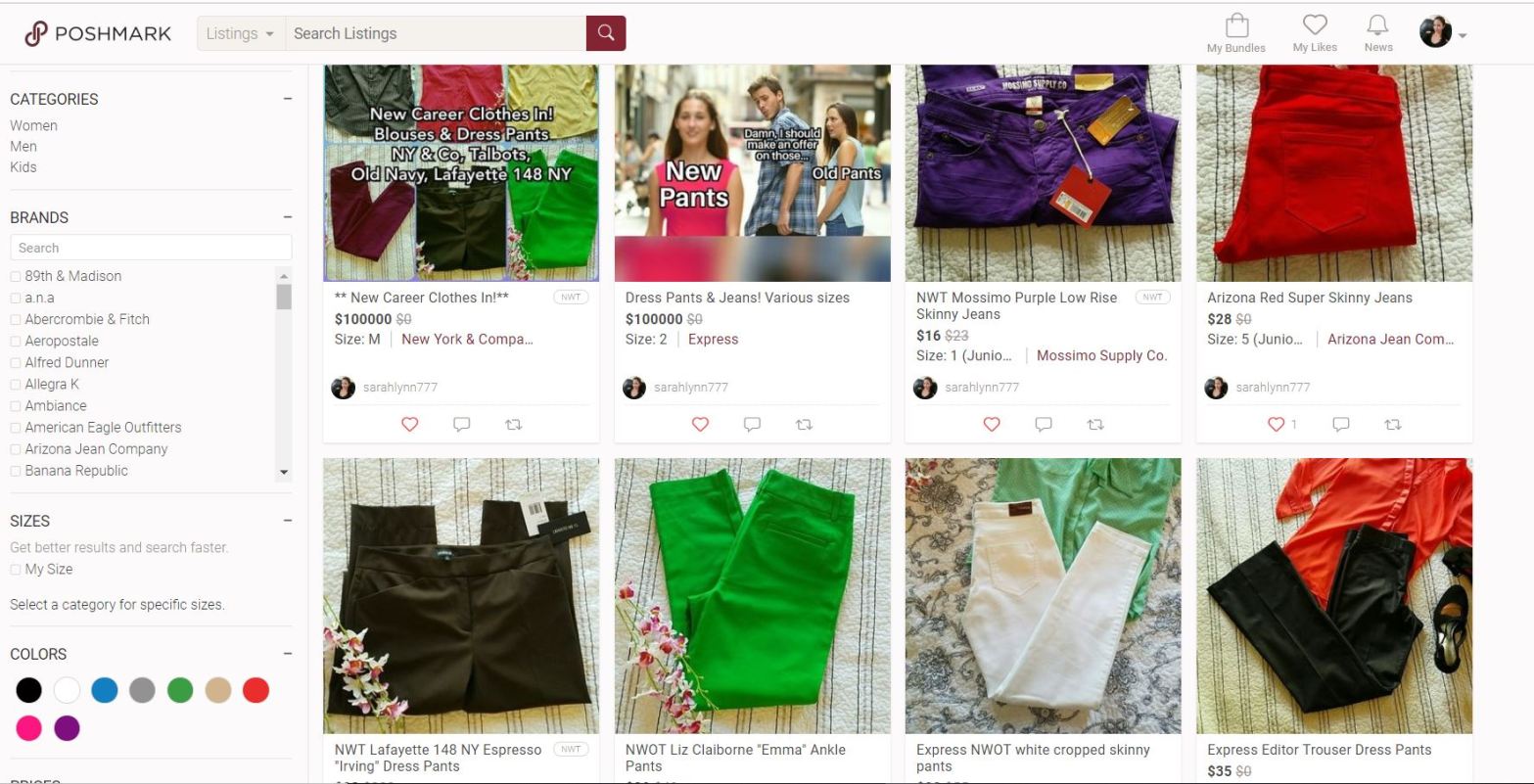
Fast-forward to about a year ago when my friend told me about Poshmark, an app where you can easily buy and sell clothes on your smartphone (oh, the hours I would’ve saved at 18 if smartphones had been a thing)! Initially I just used it to buy stuff. I had recently put some weight on and needed to size up some of my pants. I found some awesome deals on Express jeans and work clothes, mostly new with tags, and some shoes. I then realized that, like I did when I was 18, at least more than half of my closet was filled with stuff that either didn’t fit or made me feel frumpy. Many of these things still had tags. I had at least five pairs of shoes that I’d worn once or twice or never. So I started listing them.
My intention in the beginning was to simply replace all the clothes in my closet that were ugly or too small with stuff that fit and looked good on me. I would wait until enough of my stuff sold that I could use those credits to buy “new” things on Poshmark.
Eventually, it got to the point where I had replaced all the clothes I needed and still had a balance of about $50 left over, so I linked my bank account and transferred it over.
Then I started accumulating a balance almost every week, so I made a spreadsheet. In just a few months of casually listing stuff I didn’t want, I’d sold about $200 and replaced about half my wardrobe with new stuff I loved, with only a few purchases getting relisted for being the wrong size. That’s not a lot of profit, but it was enough to motivate me to want to get more serious.
It’s Not For Everyone
One thing you need to know up front if you’re considering online resales: It’s not for everyone. It’s a lot of work—frankly way more than I thought it would be. And all that work is necessary if you want to see any sort of actual profit.
The work doesn’t stop at listing your item. If you want to be serious, you’e going to have to do so much more, including sourcing more items when your personal inventory inevitably runs out, learning a bit of photography if you’re not well-versed, sharing or otherwise promoting your listings to attract more buyers, running the occasional sale to entice more buyers, and don’t forget about shipping!
You’re going to have to make time to go to the post office, FedEx, UPS, etc., quite often. You’ll also have to deal with the occasional buyer who sends you message after message asking where their stuff is even though they have a tracking number and you have no control over the shipping process once the item leaves your possession, which can be very annoying! (Just keepin’ it real.)
I’ve always loved fashion, though, so spending some time every day scrolling trough cute clothes and clicking Share is a fun time for me. It’s kinda like scrolling through Pinterest and doing nearly the exact same thing for free.
General Resale Tips
Photography
Photography is everything. If your photos look like crap, no one will want to buy them. This should be obvious, but sometimes we think that, because we’re listing used stuff online, people should assume it’s not going to look like it would in a fashion catalog.
But at the same time, you still want people to find your stuff enticing, right. Otherwise, why tf would they buy it?
Every time you take a photo of something you plan to list, stand back and look at it objectively. Would you want to buy it? If the answer is no, then you need better photos. Try browsing Pinterest boards for inspiration.
Natural Light Is Your Friend
The last thing you want to do is take a photo of something hanging limply on a hanger in a dimly lit room at night. I guarantee you that photo will look like sh**. Anything white will be yellow, and ugly shadows will distort the shape.
If you don’t have special lighting for indoor photography, it’s best to take all photos in the daylight. I lay mine flat on my bed—ironing them first, if necessary—over a neutral-colored bedspread and open all the windows to let in the natural light.
Be Pinterest-Worthy
You’ve seen photos of clothes on Pinterest. Mimic what they look like. Arrange little outfits so shoppers can see what’s possible with the garment you’re selling. Make them look shareable.
General Poshmark Tips
Be Social
Poshmark is designed to work as a social-sharing platform. You follow people and share their stuff, and they follow you back and share your stuff. Sharing increases your closet’s exposure and bumps your items up in searches. This also means you have to spend some time on the app—five minutes here, ten minutes there—sharing your stuff as well as stuff in your news feed.
Sharing is Caring. It’s Also Branding
Poshmark recommends new listings based on your in-app search history as well as the things you list for sale, your likes, the people and brands you follow, and especially the things you share. That means you don’t want to just mindlessly click the Share button for no reason. Only share things you really like and would actually wear yourself.
Definitely share your own stuff on a regular basis, especially at night, which is prime online shopping time! Poshmark regularly hosts themed “parties” where sellers are encouraged to share all their theme-appropriate stuff, and those parties are great opportunities for more exposure and more followers, shares, and likes—which ultimately translate to more sales.
Don’t Be Ridiculous
Meaning don’t price your stuff unreasonably. The mind-set of Poshmark shoppers is to find great new or gently used brands at a bargain. We can call secondhand shopping by whatever cutesy euphamism we want, but it’s still secondhand shopping. Things that are new with tags are expected to at least be off-price; think TJ Maxx or Ross. Why would someone want to buy your secondhand item online and wait for it to be shipped to them at retail prices when they can just go to an off-price store?
Which brings me to my next point…
“Pick” Appropriately
Your personal inventory will not last forever. If you’re serious about online resale, you’re gonna have to go picking at some point to replenish your inventory.
DON’T Go Picking at Off-Price Stores
…such as TJ Maxx, Ross, Marshalls, and others. To reiterate, buyers on these types of platforms expect items to already be off-price, so sourcing items from off-price retailers doesn’t make sense. Your margins won’t be good enough to turn a profit, and pricing items at MSRP won’t get you many serious buyers, but it will get you a lot of lowball offers.
What About Poshmark’s Wholesale Market?
It doesn’t take much to “qualify” to buy things from the Poshmark wholesale market, which sells bundles of clothing by indie brands for sellers to resell as “boutique” items, but are they really worth it?
These wholesale items will come with a suggested MSRP, but those suggested prices don’t generally fall into the realm of what the average Poshmark buyer would be willing to pay for something by an unknown brand unless it’s something really on-trend. I have seen some pretty cute holiday-themed stuff.
Personally, I don’t see much potential for the wholesale market. How it works is you buy a bundle of items and then list them for sale at whatever price you want up to their suggested MSRP as Boutique items in your closet. You may or may not be able to use the same photos the wholesaler uses on Poshmark. Lots of people see this as a good way to make a profit, but don’t forget that most buyers make offers rather than click the Buy Now button. Admittedly, very few of my sales have gone for the actual price I listed them for (which is why I list them a little higher than what I really want in the first place—offers are expected).
I mean, you can say “Price is firm!” in your listing, but it’ll come across as rude, especially with the exclamation point.
If you are a boutique seller on Poshmark, I would be interested in hearing your own experiences!
Better Ways to Pick
Go Thrifting!
Hit up thrift stores in high-end locations. This is a no-brainer for the most savvy resellers.
For the best chances of success, avoid going on weekends. Those are the busy days, and employees typically don’t restock their donations on weekends. The best time to go thrifting would be the first half of the week. [I usually go on a Tuesday after work.]
Spring is the best time of year to go thrifting because people are inspired to get rid of as much stuff as possible during spring cleaning, and this motivation makes them less likely to care about the brand or quality of the things they donate; all they want is a clean closet.
Thrift stores such as Goodwill and Salvation Army, as well as any mom-and-pop stores that don’t use the words “vintage” or “consignment” in their names, are the best places to source items. This is because they operate wholly on donations and don’t check for things like brand and quality. These stores have “departments” with uniform prices for all items of the same category (e.g., $4 all jeans, $5 all jackets, $6 all shoes).
Use Other Selling Apps
Another thing I do is search for “bundles” of items on other selling platforms. I search for quality, well-known brands in excellent used condition or that are new with tags. Look for motivated sellers listing “bundles” and “lots.” These types of sellers just want to get rid of lots of stuff and are less concerned with profit.
I usually use Mercari for this. I’ll search for “bundle” or “lot,” filter it by Women and For Sale, and further refine the price range to up to something like $30 or $40. Using this method, I got a bundle of six pairs of new Hollister jeans for $27 and free shipping and a bundle of six juniors mini dresses, 5/6 new with tags, for $16.
Also:
Don’t Put All Your Eggs In One Basket
If you plan to be very active with your phone and other selling apps, you can be like me and list the same item(s) on multiple platforms. Currently I only use Poshmark and Mercari (and occasionally eBay, depending on what I’m listing). This method increases you stuff’s exposure to more buyers who prefer different platforms.
The reason I say to only do this if you plan to be very active on your phone is that you want to minimize the chance of different people buying the same item on different apps while you were “away,” and now you can’t fulfill one of the orders. Once something sells on one platform, you’ll want to be around to unlist it from the other(s) so this doesn’t happen. You don’t want angry or disappointed customers!
Each platform has its own pros and cons, so you’ll have to do your research, but they all share a few commonalities to consider, such as:
…Sellers Fees!
They exist. It’s how the apps make money. They vary by app but are typically small. You’ll have to do your own cost-benefit analyses to see which apps make the most sense for what you’ll be selling and how active you intend to be.
Shipping Fees
Those are also a thing, so make sure you research the options and make a decision whether it would be worth it to offer free shipping, if you use an app that gives you the choice, such as Mercari.
Poshmark will occasionally offer free shipping on items you put on sale (i.e., drop the price on) to further entice buyers, but in general, the buyer always pays for shipping on Poshmark; Mercari offers you the choice to offer free shipping, which comes out of the final sale price. Personally I only offer free shipping on stuff I really just want to get rid of.
How Mercari Differs from Poshmark
Mercari has a very easy interface and allows you to offer free sipping for shoppers. You can also sell a larger variety of items on Mercari versus Poshmark, which is fashion-focused. One thing that bothers me about Mercari is that, while on Poshmark you can share items with your followers for more shares and visibility, the only way to “promote” your stuff on Mercari is to keep lowering the price. That combined with the seller’s fee and any associated shipping costs can really eat into your margins.
 The Humble Pedant